

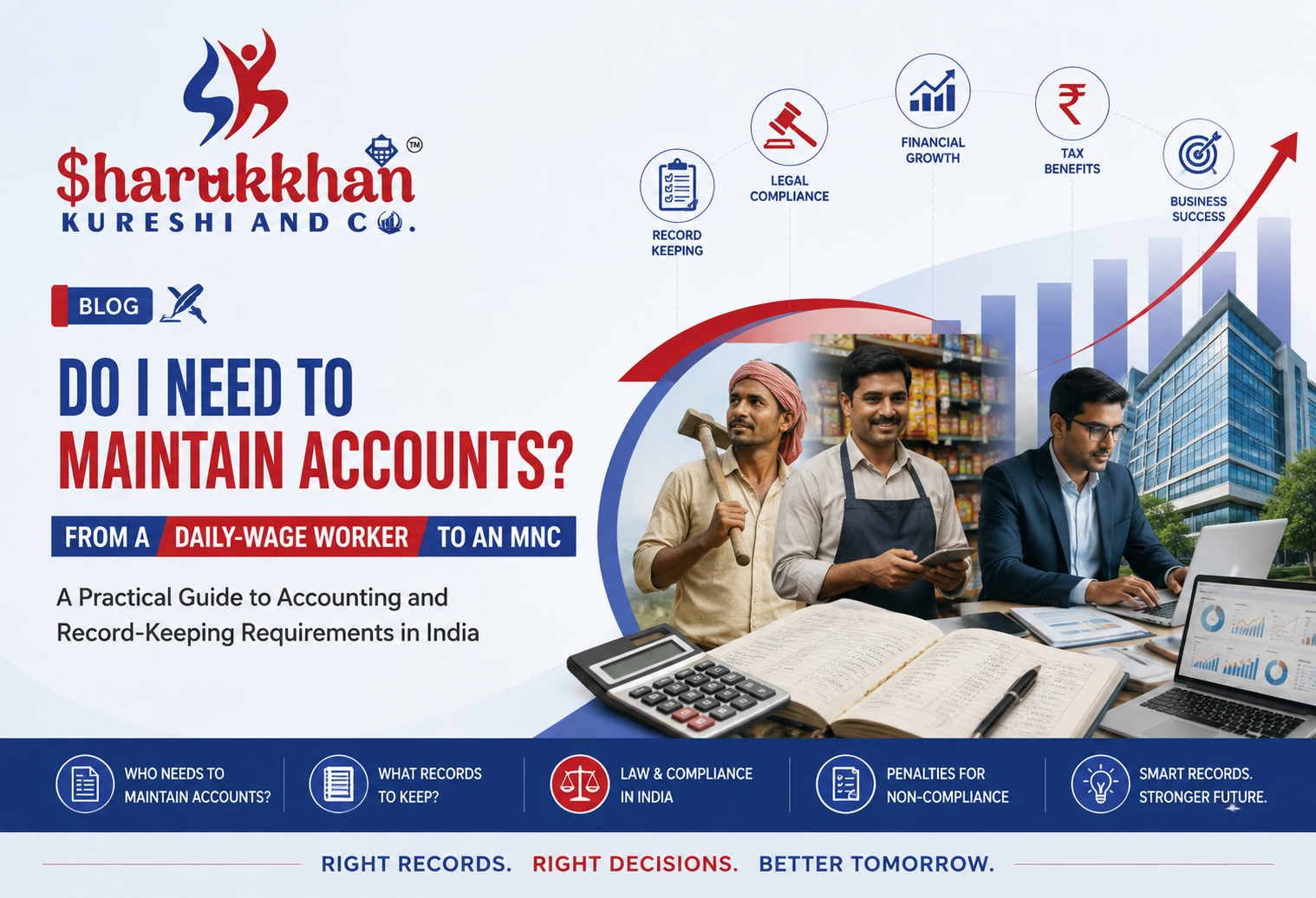
A Practical Guide to Accounting and Record-Keeping Requirements in India
Applicable position: As on 12 August 2026
Introduction
When people hear the word “accounts”, many immediately imagine a large company with a finance department, accounting software, auditors, balance sheets and annual financial statements.
But accounting does not begin when a business becomes an MNC.
It begins much earlier.
A daily-wage worker may simply keep track of wages received and household expenses. A small trader may maintain a cash book and purchase records. A professional may need books of account under income-tax law. A GST-registered business has statutory record-keeping obligations. A company has much more comprehensive accounting and financial-reporting responsibilities.
So, the real question is not: “Am I big enough to maintain accounts?”
The better question is:
“What level of financial records and books am I legally required to maintain because of my income, activity, entity type, tax registration and regulatory obligations?”
This distinction is extremely important.
A person earning wages as an employee, a self-employed individual, a proprietor, a partnership firm, LLP, private limited company and multinational corporation do not have the same accounting obligations.
This article explains the progression from the simplest financial record-keeping to sophisticated corporate accounting.
- First understand the difference: Personal records vs Books of Account
Not every financial record is legally a “book of account” in the same sense.
There are at least three different concepts:
| Level | Meaning | Typical example |
| Personal financial record | Records maintained for personal financial control | Salary received, rent, household expenses |
| Business/professional books | Records maintained to determine business/professional income and financial position | Cash book, ledger, purchase and sales records |
| Statutory accounting records | Records required under a specific law or regulation | Company books, GST records, cost records, payroll registers |
Therefore, a person may have a very good reason to maintain accounts even when a particular law does not expressly require formal books.
This is where accounting changes from merely a compliance exercise into a financial-management tool.
2. Does a daily-wage worker need to maintain books of account?
Generally, a person earning wages as an employee does not become legally required to maintain business books merely because he or she receives wages.
Suppose a worker receives:
- ₹700 per day;
- works 25 days in a month;
- receives approximately ₹17,500 per month; and
- has no independent business or profession.
That person is not carrying on a business merely because wages are received.
There is therefore an important distinction between:
Employee receiving wages
&
Self-employed person earning business income.
Example
Consider two persons:
| Particular | Person A | Person B |
| Work | Factory worker | Independent electrician |
| Income | Daily wages | Charges customers |
| Relationship | Employee | Self-employed |
| Nature of income | Employment income | Business/professional income |
| Business books under income-tax law | Generally, not applicable merely because of salary | May become applicable depending on the applicable provisions |
| Practical records | Wage slips, bank credits, personal expenses | Customer receipts, expenses, tools, purchases, bank records etc. |
The second person has crossed an important line.
He is no longer merely receiving employment income. He is conducting an economic activity independently.
3. Even a daily-wage worker should maintain basic personal financial records
“Not legally required to maintain formal books” does not mean “maintain no records.”
A person with modest income can benefit from a simple record of:
- wages received;
- bank deposits;
- cash received;
- rent;
- food expenses;
- education expenses;
- medical expenses;
- loan repayments;
- insurance;
- savings;
- investments;
- major purchases;
- money lent or borrowed.
A simple monthly statement can be enough:
| Particular | Amount |
| Wages received | ₹18,000 |
| Other income | ₹1,000 |
| Total receipts | ₹19,000 |
| Household expenses | ₹10,000 |
| Loan repayment | ₹2,000 |
| Education | ₹1,500 |
| Savings | ₹3,000 |
| Other expenses | ₹2,500 |
| Closing balance | ₹0 |
This may not be a statutory set of books, but it is financial accounting at the personal level, & there is a practical benefit.
A person who maintains records is in a much better position to demonstrate the source of money when required for a bank transaction, loan, investment or other legitimate financial purpose.
4. The moment a person starts a business, the situation changes
Suppose the same worker starts a small activity after working hours.
For example: He starts repairing electrical appliances and earns ₹15,000 per month from customers.
Now he has two sources: Employment income + business income.
The business portion needs to be examined separately. The Income-tax Act, 2025 contains specific provisions for maintenance of books of account under Section 62.
Section 62 applies to specified professions and, subject to prescribed conditions, to persons carrying on business or other professions. For individuals and HUFs, the statutory thresholds under Section 62(2)(d) are generally linked to:
- business/professional income exceeding ₹2.50 lakh, or
- sales, turnover or gross receipts exceeding ₹25 lakh,
subject to the detailed conditions of the provision.
The law also contains special rules for specified professions and presumptive taxation.
5. The accounting ladder in India
A useful way to understand the entire subject is to look at it as a ladder.
| Stage | Person/entity | Typical accounting requirement |
| 1 | Employee / wage earner | Personal financial records; employer maintains employment/payroll records |
| 2 | Small self-employed person | Basic income and expense records; statutory books may depend on applicable law and thresholds |
| 3 | Small proprietor | Business books and supporting records depending on applicable provisions |
| 4 | Presumptive taxpayer | Simplified compliance may apply, subject to conditions |
| 5 | Profession | Specific record requirements may apply |
| 6 | GST-registered business | GST books and records in addition to income-tax requirements |
| 7 | Partnership / LLP | Entity-level accounting and tax records |
| 8 | Company | Statutory books of account, financial statements and corporate records |
| 9 | Large company | Detailed financial reporting, internal controls, audit, tax, GST, payroll, regulatory and management accounting |
| 10 | MNC / large regulated group | Multi-layer financial reporting, consolidation, transfer pricing, Ind AS/IFRS-related requirements, tax and regulatory reporting, internal controls and group reporting |
The important lesson is:
Accounting obligations generally become more extensive as the complexity of the economic activity increases.
6. Small trader: “I only have a small shop. Do I need accounts?”
Consider a small grocery shop.
The proprietor may initially think:
“I purchase goods for ₹50,000 and sell them for ₹60,000. Why do I need accounting?”
But even this simple business involves:
- purchases;
- sales;
- cash;
- bank;
- inventory;
- creditors;
- debtors;
- rent;
- electricity;
- salaries;
- transport;
- GST, where applicable;
- business assets;
- loans;
- drawings;
- profit.
A basic accounting system might therefore include:
Minimum practical records
- Cash book
- Bank book
- Purchase register
- Sales register
- Expense records
- Debtors list
- Creditors list
- Inventory records
- Fixed asset records
- Loan records
- GST records, where applicable
- Supporting bills and vouchers
This is why the statement “small business does not need accounts” can be dangerously misleading.
The correct answer is:
The statutory requirement depends upon the nature and scale of the activity and the applicable law, but maintaining reliable records is commercially and financially important even where full statutory books are not mandatory.
7. Presumptive taxation does not mean “no financial records whatsoever”
This is one of the most misunderstood areas.
India provides presumptive taxation schemes for eligible taxpayers.
The purpose is to simplify tax computation for certain eligible businesses and professions.
Under the current income-tax framework, presumptive taxation provisions include provisions such as Sections 58 and 61 of the Income-tax Act, 2025, corresponding broadly to the earlier presumptive-tax framework.
For eligible taxpayers, the law can reduce the burden of maintaining regular books in certain circumstances.
However:
Presumptive taxation should not be interpreted as permission to destroy or ignore all financial evidence.
A prudent taxpayer should still preserve:
- bank statements;
- invoices;
- receipts;
- major expense evidence;
- loan documents;
- asset purchase records;
- GST records, if applicable;
- TDS certificates;
- investment records;
- relevant business correspondence.
The Income-tax Department itself explains that presumptive taxation is intended to reduce the compliance burden associated with regular books, subject to the conditions of the applicable scheme.
8. Professionals have a different accounting dimension
Professionals such as:
- doctors;
- lawyers;
- engineers;
- architects;
- cost accountants;
- chartered Accountants;
- company secretaries;
- general accountants;
- technical consultants;
- interior designers;
- IT professionals;
may fall within the specified-profession framework.
Section 62(4) of the Income-tax Act, 2025 identifies specified professions including legal, medical, engineering, architectural, accountancy, technical consultancy, interior decoration, information technology and company secretary, along with professions that may be notified.
For certain specified professionals, prescribed books and documents may be required, subject to applicable conditions and presumptive-tax provisions.
Therefore:
A professional should not automatically assume that “I am an individual, so I do not need books.”
The nature of the profession matters.
9. GST creates another layer of accounting records
A business may have obligations under GST in addition to income-tax requirements.
Section 35 of the CGST Act requires a registered person to maintain true and correct accounts and records & The records may cover matters such as:
- production/manufacture;
- inward and outward supplies;
- stock;
- input tax credit;
- output tax;
- tax payable;
- tax paid;
- other prescribed particulars.
This creates an important principle:
Income-tax books and GST records are related, but they are not automatically the same compliance requirement.
For example:
A business may maintain a financial ledger showing sales of ₹1 crore.
Its GST records may additionally require detailed information regarding:
- taxable supplies;
- exempt supplies;
- zero-rated supplies;
- HSN/SAC;
- GST rate;
- output tax;
- ITC;
- credit/debit notes;
- e-invoices, where applicable;
- e-way bills, where applicable.
Therefore, GST reconciliation with financial accounts becomes increasingly important as a business grows.
10. From proprietor to partnership and LLP
When a business moves from individual ownership to a partnership or LLP structure, the accounting framework becomes more formal.
| Area | Typical records |
| Capital | Partner/member capital accounts |
| Transactions | Journal and ledger |
| Cash | Cash book |
| Banking | Bank book and reconciliations |
| Revenue | Sales/service records |
| Expenses | Expense ledgers and vouchers |
| Assets | Fixed asset register |
| Inventory | Stock records |
| Tax | Income-tax/GST/TDS records |
| Loans | Loan schedules |
| Partners | Drawings, remuneration, interest etc. |
| Financial reporting | P&L and Balance Sheet |
Typical records may include:
The accounting system should also be capable of distinguishing business transactions from personal transactions.
That distinction becomes increasingly important as the organisation grows.
11. Company: the legal requirement becomes much more formal
The situation changes substantially once an entity becomes a company.
Section 128 of the Companies Act, 2013 requires every company to prepare and keep books of account and other relevant books and papers and financial statements that give a true and fair view of the state of affairs of the company.
The section also requires the books to be maintained on:
- accrual basis, and
- double-entry system of accounting.
Books may also be maintained electronically in accordance with the prescribed requirements.
This is fundamentally different from a person simply maintaining a personal income-and-expense diary.
12. What does “books of account” mean for a company?
The Companies Act definition is broad.
It includes records relating to:
- money received and expended;
- receipts and expenditure;
- sales and purchases of goods and services;
- assets and liabilities;
- prescribed cost items for applicable companies.
Thus, company accounting is not simply:
Sales minus expenses = profit.
It is a structured financial information system.
13. How the accounting requirement expands as the business grows
Consider the following imaginary journey.
Stage 1: Daily-wage worker
Income: ₹15,000 per month
Practical records:
- wages received;
- bank account;
- personal expenses;
- savings;
- loans.
Formal business books: generally, not applicable merely because the person is a wage employee.
Stage 2: Small self-employed worker
Business income: ₹2 lakh per year
Records may include:
- customer receipts;
- material purchases;
- tools;
- transport;
- bank;
- cash;
- expenses.
Applicable statutory requirements need to be evaluated based on the exact nature of the activity and the law.
Stage 3: Growing proprietor
Turnover: ₹20 lakh
Now the business may have:
- inventory;
- debtors;
- creditors;
- employees;
- GST considerations;
- bank finance;
- business assets;
- tax records.
Accounting becomes much more useful.
Stage 4: Established business
Turnover: ₹5 crore
At this stage, accounting is no longer merely for preparing an income-tax return.
Management may need:
- monthly P&L;
- balance sheet;
- cash flow;
- receivable ageing;
- payable ageing;
- inventory ageing;
- gross-margin analysis;
- product profitability;
- budget vs actual;
- working-capital analysis;
- bank reporting;
- tax compliance.
Stage 5: Large company
Turnover: ₹500 crore
Now accounting may involve:
- ERP;
- multiple business units;
- multiple branches;
- fixed asset management;
- inventory systems;
- payroll;
- GST;
- TDS;
- statutory audit;
- internal audit;
- internal financial controls;
- management reporting;
- financial consolidation;
- board reporting;
- regulatory reporting;
- cost accounting and cost audit, where applicable.
Stage 6: MNC
Turnover: ₹5,000+ crore
The accounting ecosystem may involve:
- ERP;
- consolidation;
- group reporting;
- transfer pricing;
- related-party transactions;
- inter-company reconciliations;
- foreign currency accounting;
- deferred tax;
- Ind AS / applicable accounting framework;
- global reporting packages;
- internal controls;
- risk management;
- statutory audit;
- tax audit;
- GST;
- customs;
- FEMA;
- sustainability/ESG reporting where applicable;
- cost records/cost audit where applicable;
- segment reporting;
- management accounting;
- financial planning and analysis.
At this stage, the accounting department is not simply recording history. It becomes a decision-making system for management.
14. Income-tax books and tax audit are two different things
This distinction deserves special attention.
Books of account
These are records maintained to capture and substantiate the financial activity of the business/profession.
Tax audit
Tax audit is an additional statutory requirement that applies when the prescribed conditions are met.
Under Section 63 of the Income-tax Act, 2025, tax audit thresholds include:
| Category | Broad threshold |
| Business | Turnover/gross receipts exceeding ₹1 crore |
| Business with prescribed low-cash conditions | Threshold can increase to ₹10 crore |
| Profession | Gross receipts exceeding ₹50 lakh |
| Certain presumptive-tax situations | Special provisions can trigger audit |
The exact applicability must always be tested against the detailed statutory conditions, including presumptive-tax provisions.
Therefore: “Books required” and “tax audit required” are not synonymous.
A person may have to maintain books even though tax audit is not required.
15. A simple example of the difference
Suppose a professional has gross receipts of ₹30 lakh.
The question should not be: “Is ₹30 lakh below the tax-audit limit?”
The analysis should be:
- What profession is being carried on?
- Is it a specified profession?
- Is the taxpayer an individual, firm or another entity?
- Has a presumptive scheme been adopted?
- What are the applicable book-maintenance requirements?
- Does the tax-audit threshold apply?
- Are GST records also applicable?
- Are there any other regulatory records?
This is why professional compliance cannot be determined merely by looking at turnover.
16. Employees: the accounting may be on the employer’s side
There is another important perspective. A daily-wage worker may not be required to maintain business books.
But the employer may have statutory obligations to maintain employment and wage records.
The labour-law framework now includes the Code on Wages, 2019 and the Occupational Safety, Health and Working Conditions Code, 2020, both of which contain record-keeping requirements for covered establishments.
For example, current rules provide for records such as:
- employee registers;
- attendance/muster rolls;
- wage records;
- overtime;
- deductions;
- wage slips.
The Occupational Safety, Health and Working Conditions Code, 2020 has an enforcement date of 21 November 2025, and its framework includes maintenance of registers, records and returns.
Therefore: The worker may not need to maintain business books, but the employer may need detailed records concerning that worker.
This distinction is particularly important for contractors, factories, construction businesses, establishments and organisations employing significant numbers of workers.
17. Where does Cost Accounting enter the picture?
This is where accounting becomes particularly interesting for manufacturing and certain service-sector companies.
Financial accounting answers questions such as:
“What is the total profit?”
Management accounting asks:
“Why did we earn this profit?”
Cost accounting goes further:
“What did each product, service, process, department, activity or unit actually cost?”
For an applicable company, cost records may capture areas such as:
- material consumption;
- labour;
- production overhead;
- utilities;
- process costs;
- capacity utilisation;
- production quantities;
- cost per unit;
- inventory;
- product/service profitability.
Under Section 148 of the Companies Act, 2013 and the applicable Companies (Cost Records and Audit) Rules, 2014, specified classes of companies are required to maintain cost records, and certain classes are also subject to cost audit requirements.
This is a completely different level of accounting sophistication from the personal records of an individual.
18. The accounting pyramid
The progression can be represented as follows:
PERSONAL FINANCE
↓
Income and expense records
↓
SELF-EMPLOYED / SMALL BUSINESS
Cash, bank, sales, purchases, expenses
↓
PROPRIETORSHIP
Ledger + inventory + receivables + payables + tax records
↓
PARTNERSHIP / LLP
Entity accounting + partner/member accounts + tax compliance
↓
COMPANY
Double-entry books + financial statements + statutory records
↓
LARGE COMPANY
ERP + internal controls + audit + MIS + tax + regulatory reporting
↓
MNC / GROUP
Consolidation + group reporting + transfer pricing + cross-border transactions + global controls + advanced management accounting
19. Accounting is not only about compliance
There is a common misconception: “Accounts are maintained because the Income-tax Department or GST Department may ask for them.”
That is only one reason.
A good accounting system can answer much more important business questions.
For an individual
- Where is my money going?
- How much can I save?
- Can I afford a loan?
For a small business
- Which customer owes me money?
- Which supplier should I pay?
- How much profit did I really earn?
- Where am I losing money?
For a growing business
- Which product is profitable?
- What is my working-capital requirement?
- What is my break-even point?
- Can I afford another employee?
- Should I borrow from the bank?
For a large company
- Which business segment is creating value?
- What is the cost per unit?
- Where is capacity underutilised?
- Why is EBITDA falling?
- What is the return on capital?
- Which business should management expand, restructure or discontinue?
This is the difference between bookkeeping and management accounting.
20. A practical record-keeping matrix
| Person/ Entity | Basic records | Formal books | Tax records | GST records | Audit/ assurance |
| Daily-wage employee | Recommended | Generally, not as employee | Depends on income profile | Usually not merely as employee | Not merely due to wages |
| Self-employed individual | Yes | Depends on Section 62 and facts | Yes, where applicable | If registered/ applicable | Depends on law |
| Small proprietor | Yes | Depending on law/threshold | Yes | If applicable | Depending on Section 63 and other laws |
| Presumptive taxpayer | Supporting records strongly advisable | Simplified treatment may apply subject to conditions | Yes | If applicable | Special rules |
| Specified professional | Yes | Prescribed requirements may apply | Yes | If applicable | Depending on provisions |
| Partnership | Yes | Entity-level accounting | Yes | If applicable | Depending on provisions |
| LLP | Yes | Formal accounting | Yes | If applicable | Depending on provisions |
| Company | Extensive | Mandatory statutory books | Yes | If applicable | Statutory audit and other applicable audits |
| Cost-record applicable company | Extensive | Financial + cost records | Yes | If applicable | Cost audit where applicable |
| MNC | Highly sophisticated | Extensive | Multiple tax/regulatory layers | Often extensive | Statutory, internal and other applicable audits |
Important: This table is an educational overview. Exact obligations depend on the entity type, nature of activity, turnover, tax regime, registrations, industry and applicable Central/State laws.
21. What should a small business maintain even if the law does not demand sophisticated accounting?
A practical minimum system should contain:
Daily
- sales;
- purchases;
- cash receipts;
- cash payments;
- bank transactions;
- credit transactions.
Monthly
- bank reconciliation;
- customer outstanding;
- supplier outstanding;
- inventory;
- expense review;
- GST reconciliation where applicable;
- tax deductions and payments where applicable.
Quarterly
- profitability review;
- working-capital review;
- tax position;
- debtor ageing;
- creditor ageing;
- inventory ageing.
Annually
- financial statements;
- tax computation;
- tax return;
- audit, where applicable;
- asset verification;
- stock verification;
- compliance review.
This approach creates a useful monthly accounting discipline even before a business becomes large.
22. Digital accounting is becoming the norm
Accounting no longer necessarily means maintaining physical registers.
Modern businesses may use:
- accounting software;
- ERP;
- cloud accounting;
- spreadsheets;
- banking integrations;
- inventory software;
- payroll systems;
- GST systems;
- e-invoicing systems;
- dashboards;
- automated reconciliations;
- document management systems.
For a small business, a properly designed spreadsheet can sometimes be sufficient for basic management purposes.
For a large organisation, an integrated ERP and strong internal-control environment may be necessary.
The principle is: The sophistication of the accounting system should match the complexity and risk of the business.
23. What happens when records are not maintained properly?
Poor records can create problems far beyond tax.
Possible consequences include:
Tax
- difficulty substantiating income;
- difficulty supporting expenses;
- tax disputes;
- inability to reconcile returns.
GST
- ITC reconciliation issues;
- stock discrepancies;
- supply reconciliation problems;
- difficulty responding to departmental queries.
Bank finance
- weak financial projections;
- difficulty demonstrating repayment capacity;
- poor CMA data;
- weaker credit assessment.
Business management
- unknown profitability;
- cash leakage;
- uncontrolled expenses;
- poor working-capital management.
Corporate compliance
- unreliable financial statements;
- audit qualifications or observations;
- internal-control weaknesses;
- regulatory exposure.
24. The most common mistake: mixing personal and business money
One of the earliest accounting mistakes is: “It is my business, so all money is mine.”
Suppose a proprietor receives ₹10 lakh from customers and spends ₹7 lakh on business expenses.
The remaining amount is not automatically personal income that can simply be withdrawn without accounting treatment.
A proper accounting system distinguishes:
- business income;
- business expenditure;
- proprietor’s capital;
- drawings;
- business assets;
- business liabilities.
This becomes increasingly important when bank finance, GST, income tax and financial statements are involved.
25. Another common mistake: maintaining accounts only at year-end
Accounts should not be treated as an annual formality.
If accounts are updated only in March, management may discover too late that:
- receivables are overdue;
- inventory is excessive;
- margins have fallen;
- expenses are increasing;
- cash flow is deteriorating;
- GST data does not reconcile;
- tax liabilities have accumulated.
A monthly accounting system provides management with an early-warning mechanism.
26. A simple decision tree
Are you only an employee receiving salary/wages?
→ Generally, formal business books are not required merely because of employment income.
Are you carrying on a business or profession?
→ Examine Section 62 of the Income-tax Act, 2025 and applicable rules.
Are you eligible for presumptive taxation?
→ Check whether the applicable presumptive scheme changes the book-maintenance requirement.
Are you GST registered?
→ Maintain GST records as required under GST law.
Are you an LLP, partnership or company?
→ Examine the entity-specific accounting and statutory requirements.
Are you a company covered by cost-record provisions?
→ Examine the Companies Act and Companies (Cost Records and Audit) Rules.
Are you employing workers?
→ Examine applicable labour-law record and register requirements.
Is the business large?
→ Move beyond statutory compliance and establish MIS, internal controls, budgeting, costing and management reporting.
27. The real philosophy: “Every person may need financial records, but not everyone needs the same books”
This is perhaps the most important conclusion from the entire discussion.
A daily-wage worker does not need an ERP.
A small shopkeeper does not need the same accounting architecture as an MNC.
A professional does not necessarily maintain the same records as a manufacturer.
A private company does not maintain the same accounting environment as a multinational group.
But the underlying principle is the same:
Money should be traceable. Transactions should be supported. Obligations should be identifiable. Financial position should be understandable.
The scale changes. However, the accounting principle does not.
28. From a notebook to an ERP: the evolution of accounting
| Stage | Primary purpose |
| Personal notebook | Know where money goes |
| Cash book | Track receipts and payments |
| Ledger | Classify transactions |
| Financial statements | Understand financial position and performance |
| Tax records | Establish tax compliance |
| GST records | Establish indirect-tax compliance |
| Cost accounting | Understand product/service cost |
| MIS | Support management decisions |
| Budgeting | Plan future performance |
| Financial modelling | Evaluate future scenarios |
| ERP | Integrate business transactions |
| BI dashboard | Convert data into decisions |
| MNC group reporting | Integrate complex entities and jurisdictions |
This is why accounting should not be viewed merely as a statutory burden.
Accounting is the language through which economic activity becomes understandable.
29. Frequently Asked Questions
- Does a daily-wage worker need to maintain books of account?
Not merely because the person receives wages as an employee. However, maintaining personal financial records is highly advisable.
- Does every person earning income have to maintain formal books?
No. The requirement depends on the nature of income, business/profession, entity type and applicable statutory provisions.
- Does a small shopkeeper automatically need a full accounting system?
Not necessarily a sophisticated system. But the applicable statutory requirements should be examined, and proper transaction records are strongly advisable.
- Does presumptive taxation mean that no records should be maintained?
No. Presumptive taxation can simplify book-maintenance requirements subject to its conditions, but supporting financial records remain practically important.
- Is maintaining books the same as tax audit?
No. Book maintenance and tax audit are separate statutory concepts.
- Does GST require separate accounting?
GST law imposes specific accounts and record requirements on registered persons. These should be properly integrated with financial accounting.
- Does a company have to maintain books even if its turnover is low?
Yes. Company-law accounting obligations arise from the company’s status and applicable provisions, not merely from crossing the income-tax tax-audit threshold.
- Do employees need to maintain business books for their salary?
Generally, no. Salary income is different from business/professional income.
- When does accounting become important for management?
From the moment a person has income and expenditure. The level of sophistication should increase as the financial and operational complexity increases.
- Can a spreadsheet be used for accounting?
For suitable small-scale activities, a properly controlled spreadsheet can be useful. As transactions and compliance complexity increase, dedicated accounting software or ERP may become more appropriate.
30. Final conclusion
The need for accounting does not begin with an MNC. It begins with the first financial transaction.
A daily-wage worker may need nothing more than a simple personal record of income and expenses.
A self-employed person may need business records & a proprietor may require structured books.
A professional may have prescribed record requirements & a GST-registered taxpayer has GST record obligations.
An LLP or partnership needs entity-level accounting & a company must maintain statutory books and financial statements.
A large company may require financial accounting, cost accounting, taxation, internal controls, audit, MIS and financial planning.
An MNC may operate an integrated global financial architecture involving multiple entities, currencies, jurisdictions, reporting frameworks and regulatory requirements.
Therefore, the better question is not: “How big must I become before I need accounts?”
It is: “What level of accounting and record-keeping is appropriate and legally required for my present economic activity?”
And there is one more important lesson for every entrepreneur: Good accounting does not merely tell you what happened yesterday. It helps you decide what to do tomorrow.
31. Professional perspective
For a growing business, accounting should ideally develop through four stages:
Record → Comply → Analyse → Decide
At the first stage, transactions are recorded, at the second stage, statutory requirements are met, at the third stage, management analyses cost, profitability, cash flow and working capital & at the fourth stage, financial information becomes a decision-making tool.
That is where accounting stops being merely a compliance function and becomes business intelligence.
Disclaimer
This article is intended for general educational and informational purposes. The exact requirement for maintaining books, records, registers, financial statements, tax records, GST records, cost records and audit reports depends on the facts of the taxpayer/entity, nature of business or profession, turnover, registrations, applicable tax regime, industry-specific legislation and other applicable Central or State laws.
The legal position should be checked against the applicable legislation, rules, notifications and amendments prevailing for the relevant tax year before taking a compliance decision.
Legal position considered for this article: 12 August 2026.
