

Abstract
The pharmaceutical industry is among the fastest-growing and highly regulated sectors, requiring significant investment in manufacturing facilities, machinery, quality control systems, regulatory compliance, and working capital. In such a capital-intensive environment, access to institutional finance becomes essential for setting up and expanding pharmaceutical businesses. However, financial institutions and banks require comprehensive financial evaluation before extending credit facilities. In this context, project report preparation and banking ratio analysis play a vital role in determining the financial viability, sustainability, and repayment capability of pharmaceutical enterprises.
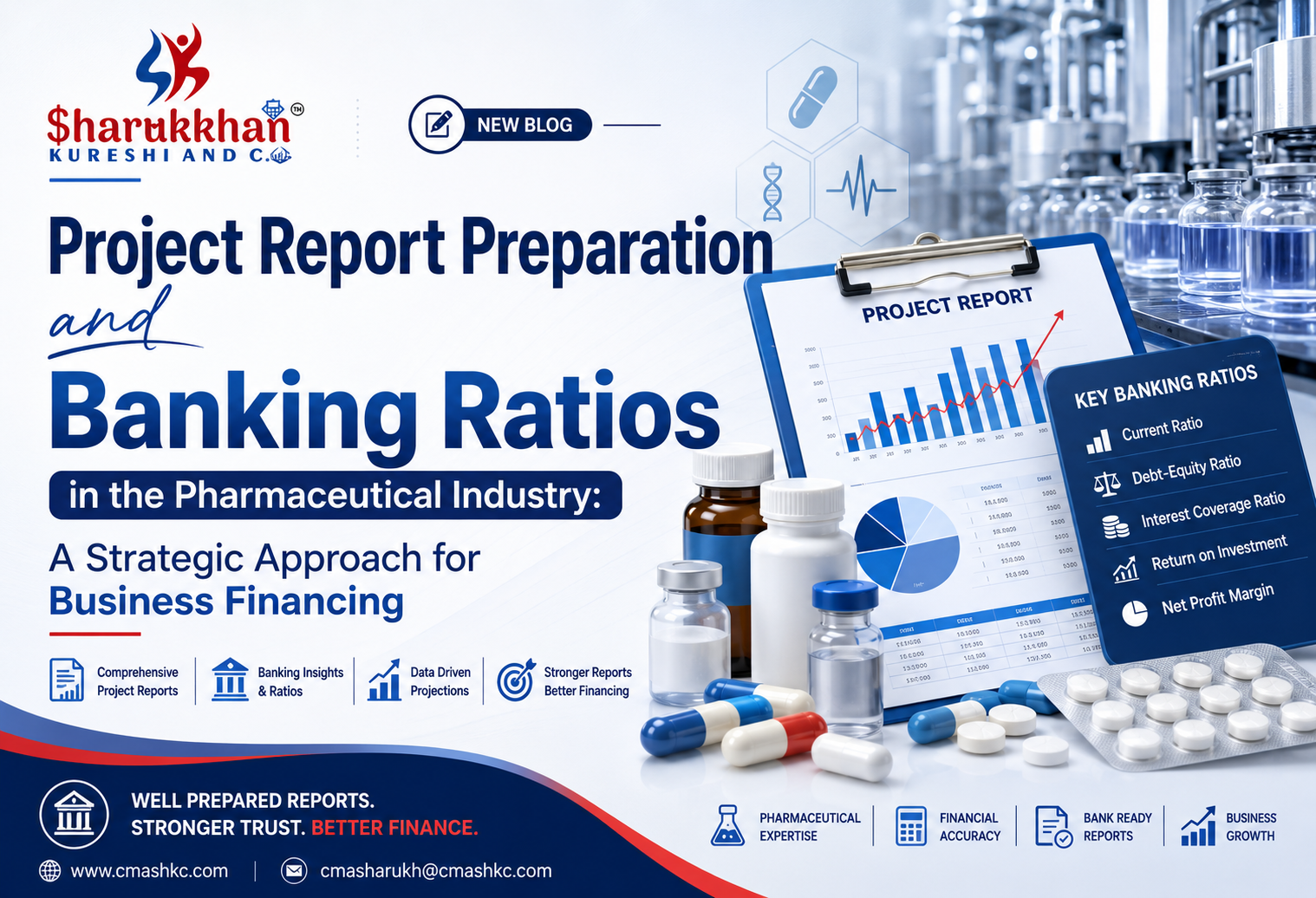
A well-structured project report serves as a roadmap for business planning and acts as a key document for lenders in assessing technical feasibility, market potential, operational efficiency, and projected profitability. Simultaneously, banking ratios such as the Debt Service Coverage Ratio (DSCR), Current Ratio, Debt-Equity Ratio, and Break-even Analysis help evaluate liquidity, financial stability, debt servicing capacity, and overall business performance.
This article explores the strategic importance of project report preparation and banking ratios in pharmaceutical financing, particularly in formulation-based businesses such as tablets, capsules, oral liquids, and ointments. It further emphasizes the critical role of Cost Accountants in preparing realistic financial projections, cost analysis, feasibility studies, and bankable project reports. A professionally prepared project report supported by sound banking ratios not only improves the probability of loan approval but also strengthens long-term business sustainability and financial discipline in the pharmaceutical industry.
Introduction
The pharmaceutical industry plays a vital role in healthcare systems and contributes significantly to industrial growth, exports, employment generation, and medical innovation. India has emerged as one of the leading pharmaceutical manufacturing hubs globally due to cost efficiency, quality production, and strong demand for medicines.
The pharmaceutical sector includes:
- Pharmaceutical manufacturing units
- Generic medicine manufacturing
- Medicine wholesale and distribution businesses
- Medical agencies and stockiest
- API (Active Pharmaceutical Ingredient) production
- Hospital supply chains
- Pharma packaging and allied services
Although the sector offers promising growth opportunities, pharmaceutical businesses require considerable investments in plant and machinery, regulatory approvals, laboratory equipment, warehouse infrastructure, quality control systems, inventory maintenance, and working capital.
Banks and financial institutions provide funding support, but before sanctioning finance, lenders conduct detailed credit appraisal based on two essential elements:
- Professional Project Report Preparation
- Banking Ratio Analysis
These components help lenders assess project feasibility, financial sustainability, repayment capability, and risk exposure.
- Importance of Project Report Preparation in the Pharmaceutical Industry
A project report is a detailed financial and operational document prepared to evaluate the viability of a proposed pharmaceutical project. It acts as a roadmap for entrepreneurs and serves as the primary document for banks while evaluating financing proposals.
In the pharmaceutical sector, project reports become even more important because of:
- High investment requirements
- Regulatory compliance requirements
- Long gestation periods
- Significant working capital needs
- Quality control obligations
- Market competition and pricing pressure
A professionally prepared pharma project report provides confidence to lenders regarding the technical feasibility, operational capability, and profitability of the proposed business.
Major Objectives of Pharma Project Reports
The primary objectives include:
- Evaluating project feasibility
- Estimating cost of project implementation
- Assessing profitability potential
- Estimating working capital requirements
- Determining repayment capability
- Supporting loan sanctioning decisions
- Essential Components of a Pharmaceutical Project Report
- Executive Summary
This section provides a concise overview of the business proposal, including:
- Name and Nature of pharmaceutical business
- Key Personal and Experience
- Brief details of Product
- Estimated Project Cost
- Funding requirements
- Promotors’ Contribution
- Expected turnover and profitability and
- Techno-Economic Viability
- Promoter Background and Management Profile
Banks evaluate promoter capability before approving finance.
This includes:
- Educational qualifications
- Experience in pharma business
- Financial background
- Existing business track record
- Creditworthiness
- Existing Venture in same nature
- Company feasibility (if Existing)
- Products and Its process
Promoters with pharmaceutical experience generally receive favorable consideration.
- Market Analysis and Industry Potential
A pharmaceutical project report should include market analysis covering:
- Market Cap for Medicine (Domestic and Indigenous)
- Installed Capacity (Domestic and Indigenous)
- Market growth (in %) (Domestic and Indigenous)
- Competitor analysis
- Product categories
- Regional market opportunities
- Pricing strategy
- Export opportunities
Strong market research strengthens confidence among lenders.

*Image is just for educational not claimed any credit and confirm about data.
- Cost of Project
A pharma business generally requires investment in:
- Land and building
- Manufacturing machinery
- Non-Manufacturing Machinery
- Quality control laboratory equipment and Electrification
- Computer, Printer and IT Infrastructure
- Furniture and Fixture
- Packaging units
- HVAC systems
- Storage and cold chain facilities
- Licensing and compliance costs
- Preliminary and Pre-Operative Expenditure
- Initial working capital
Accurate estimation of project cost is essential to avoid under-financing or over-borrowing.
- Means of Finance
Banks analyze how the project will be funded.
Typical sources include:
- Promoter’s contribution
- Bank term loan
- Working capital finance
- Unsecured loans
- Government subsidies or incentives
Generally, lenders expect promoter participation to demonstrate commitment and reduce financing risk.
- Financial Projections
Financial projections form the core of any pharmaceutical project report.
Banks generally require projections for 7 to 10 years (Depending on loan Tenuar), including:
- Projected Profit and Loss Account
- Projected Balance Sheet
- Cash Flow Statement
- Sources and Dispositions of Funds
- Statement of Important Financial Ratios
- Break-even Analysis
- Calculation of Pay Back Period and IRR
- Statement of Sensitivity Analysis
- Working Capital Assessment
These projections helpevaluate long-term sustainability.
- Importance of Banking Ratios in Pharma Financing
Banking ratios are critical indicators used by lenders to evaluate the financial health and repayment capacity of pharmaceutical businesses.
Because pharma businesses involve large inventory cycles and compliance costs, banks closely monitor financial ratios before sanctioning loans.
- Debt Service Coverage Ratio (DSCR)
The Debt Service Coverage Ratio measures whether the pharmaceutical business can comfortably repay debt obligations from operational earnings.
DSCR = {[PAT + Depreciation + Interest on Long and Medium Term] / [Repayment of Long and Medium Term + Interest on Long and Medium Term]}
This ratio measures the borrower’s ability to repay loan installments and interest from operational income.
A DSCR above 1.50 is generally considered favorable by banks.
Significance of DSCR:
- Measures repayment capability
- Indicates debt servicing strength
- Reduces lending risk for banks
- Supports higher loan eligibility
For example, if annual debt obligations are ₹10 lakh and operational income is ₹18 lakh, the DSCR becomes 1.8, indicating healthy repayment capacity.
- Current Ratio
The current ratio evaluates short-term liquidity and the ability of a business to meet current obligations.
Current Ratio = {Total Current Assets/ [Total Current Liabilities + Current Bank Finance]}
Banks generally prefer a minimum current ratio of 1.25:1.
Importance of Current Ratio:
- Measures liquidity position
- Indicates short-term financial health
- Helps assess working capital adequacy
A poor liquidity position raises concerns regarding repayment of operational liabilities.
- Debt Equity Ratio
The debt-equity ratio measures the relationship between borrowed funds and owner’s contribution.
Debt/Equity Ratio = {Total of (Term Loan) + (Working Capital Loan)/ (Total of Promotor’s Equity including Unsecured Loan from Promotors)}
This ratio helps banks determine whether the business is excessively dependent on external borrowings.
Importance:
- Evaluates financial leverage
- Measures risk exposure
- Indicates promoter commitment
A lower debt-equity ratio generally reflects better financial stability.
- Interest Service Coverage Ratio (ISCR)
The ISCR measures the ability of a business to pay interest expenses from operational profits.
Banks use this ratio to determine whether a borrower can comfortably manage interest obligations.
- Fixed Asset Coverage Ratio (FACR)
This ratio evaluates whether fixed assets adequately cover secured term borrowings. Banks prefer strong asset backing to reduce credit risk.
- Break-even Analysis
Break-even analysis helps determine the minimum sales required to cover total costs.
It enables lenders to assess:
- Risk exposure
- Profitability potential
- Sustainability of business operations
A lower break-even point generally indicates stronger financial feasibility.
- Role of Banking Ratios in Pharma Loan Approval
Banks evaluate project reports and financial ratios together before sanctioning:
- Pharmaceutical manufacturing loans
- Working capital limits
- Machinery finance
- Expansion finance
- Medical distribution funding
- Wholesale medicine business loans
Credit appraisal generally considers:
- Financial feasibility
- Project profitability
- Promoter background
- Market sustainability
- Repayment capability
- Compliance preparedness
A financially sound project report with healthy ratios substantially improves chances of loan approval.
- Challenges Faced by Pharmaceutical Businesses in Obtaining Finance
Despite growth opportunities, pharmaceutical businesses often face financing challenges because of:
- High compliance costs
- Regulatory licensing requirements
- Large working capital cycles
- Inventory management risks
- Delayed receivables from institutions and hospitals
- Improper financial documentation
Many loan applications fail because entrepreneurs submit incomplete or unrealistic project reports.
Professional financial planning and realistic projections are essential for successful funding.
- Strategic Role of Professional Financial Advisors
Professional guidance from Cost Accountants, Chartered Accountants, project consultants, and finance experts helps pharmaceutical businesses in:
- Preparing professional project reports
- Conducting ratio analysis
- Financial forecasting
- Loan documentation
- Working capital planning
- Credit appraisal support
Professional project structuring significantly reduces rejection risks and enhances funding opportunities.
- Importance of Cost Accountant in Preparation of Project Report
A project report is not merely a financial document prepared for obtaining bank finance; it is a strategic roadmap that determines the viability, sustainability, and profitability of a business venture. In sectors such as the pharmaceutical industry, where substantial investment, regulatory compliance, and cost control are essential, the role of a Cost Accountant becomes highly significant in project report preparation.
A Cost Accountant possesses expertise in cost analysis, budgeting, financial forecasting, operational efficiency, and profitability assessment, which are critical elements in preparing a realistic and bankable project report. Unlike generic financial estimation, a professionally prepared project report by a Cost Accountant ensures proper cost determination, risk assessment, and financial sustainability.
- Conclusion
Project report preparation and banking ratio analysis are no longer mere procedural formalities but strategic financial tools that determine the success or failure of loan applications. A professionally prepared project report demonstrates clarity of business vision, operational feasibility, and financial discipline. Similarly, healthy banking ratios provide assurance to lenders regarding repayment capability and financial stability.
In an era where financial institutions are increasingly cautious about credit risk, businesses must adopt a professional approach toward project financing. Entrepreneurs should ensure realistic financial projections, proper market assessment, and healthy ratio presentation before approaching banks for funding. Ultimately, a strong project report supported by robust banking ratios acts as the foundation of successful business financing and sustainable growth. Businesses that understand and effectively utilize these financial tools are better positioned to secure institutional finance and achieve long-term success.